Shortcode guide
This guide is for stores still using tabber-rs, the e-shop designer version of Tabber for Ecwid partner sites. tabber-rs is being retired, but the shortcodes keep working on your storefront. For the App Market version of Tabber, see Infinite Apps.
Using shortcodes
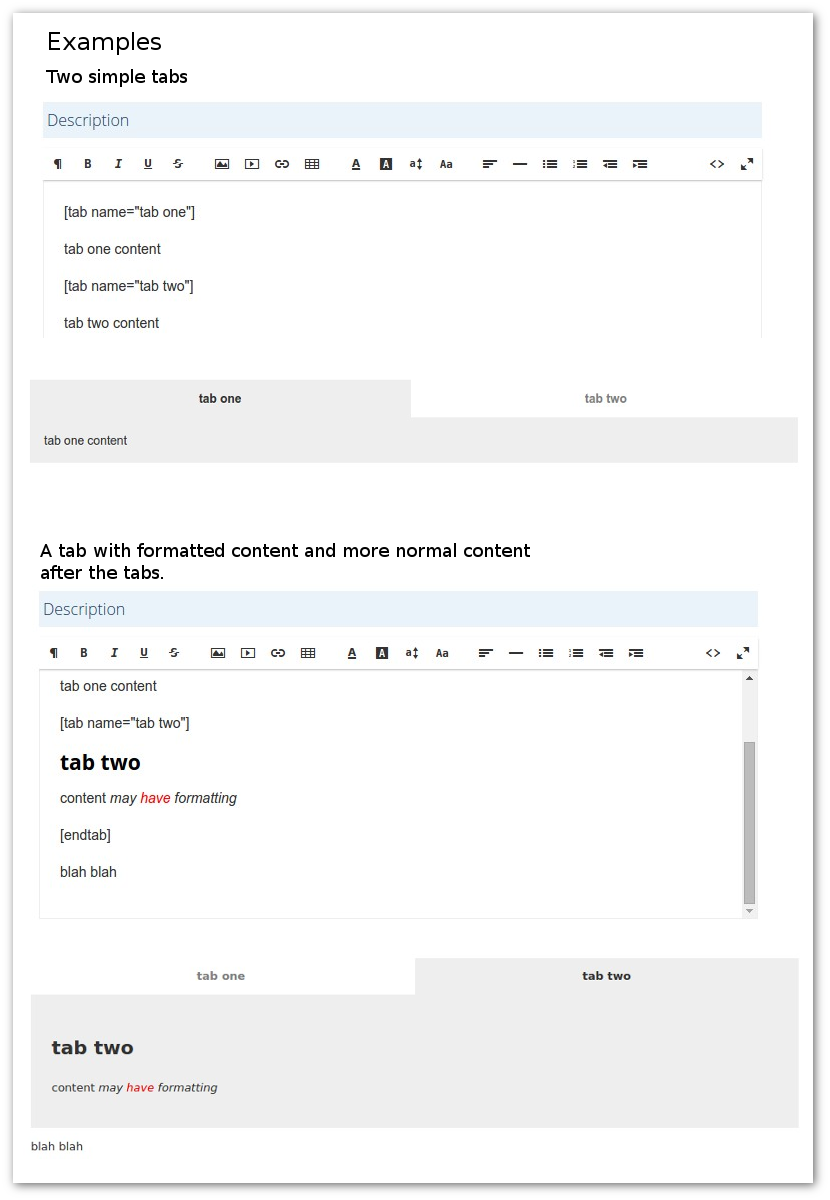
Add [tab name='tab name'] to a product or category description to start a new tab labelled "tab name".
The tab's content continues to the next tab shortcode, or to the end of the description.
If you need normal content after the tabs, add [endtab] to mark the end of all the tabs.
You can't see the tabs in the description editor. View the product on your storefront, as a customer would, to see them.
Every tab shortcode needs a name, an icon, or both. These are all the options:
- name='tab name' - the tab's label
- color='color' - colour of the tab name. Any valid CSS colour works, e.g. red, #f00 or rgba(255,0,0,1)
- icon='icon name' - an icon before the tab name
- iconafter='icon name' - an icon after the tab name
- iconcolor='color' - colour of the icon(s)
Wrap option values in quotes. Single quotes are best, because the description editor is less likely to
change them. If a tab name contains a quote, put a backslash before it (\'), or use double quotes around
the name: name="Tom's tips".
Don't format the shortcodes themselves (bold, colour, and so on), as that can stop them working. You can format the tab content between the shortcodes however you like.
Icons
Icon names come from Font Awesome version 4.7. Tabber only supports the
icons in that version. The "fa-" prefix is optional, so icon='info' and icon='fa-info' are the same.
For example, [tab name='Info' iconafter='info' iconcolor='red'] puts a red info icon after the tab name.
HTML attributes instead of shortcodes
Ecwid's Facebook, Instagram and mobile apps, and search engine results, don't run Tabber, so shortcodes show
there as text. If that matters to you, you can define tabs with HTML attributes instead. Edit the description
in HTML mode and replace each shortcode with a heading that has a data-tab- attribute. For example, replace
[tab name='Details'] with:
<h3 data-tab-name="Details">Details</h3>
Where Tabber runs this becomes a tab, and elsewhere it's a normal heading.
- The attributes use the same options as the shortcodes:
data-tab-name,data-tab-icon,data-tab-iconafter,data-tab-coloranddata-tab-iconcolor. - They work on headings (
h2toh6) and onhr,br,areaandinputtags. Addtype="hidden"to aninputtag. - Mark the end of the tabs with
data-tab-end=""on one of those tags. - Don't mix shortcodes and attributes in one description. If there's any shortcode, the attributes are ignored.
Troubleshooting
No tabs on the storefront. Check that the description contains tab shortcodes, and that you've saved the product. Tabs only appear on the storefront, not in the editor.
Shortcodes show as text on the storefront. Usually the shortcode has been formatted, or hidden formatting codes have been pasted in from a word processor. Switch the description editor to HTML mode, look at the code around the shortcode, and remove any tags inside it.
A tab has no name. The name probably has curly quotes around it, often from text copied from a word processor. Type over the quotes in the Ecwid description editor.
If you're still stuck, email support@e-shopdesigner.com until 28 February 2027.